Study Programs
Cohort-based learning with peers. Weekly sessions, curated resources, and practice.

Cohort-based learning with peers. Weekly sessions, curated resources, and practice.
A 12-week bootcamp by Algorythm, a 501(c)(3) nonprofit advancing the careers of underrepresented software engineers. With donation funded seats for 1,000 Underrepresented software engineers, this program is built around one belief: coding is the easy part. 90% of the time is spent on problem solving using abstract concepts, diagrams, and visual aids rather than any specific language.
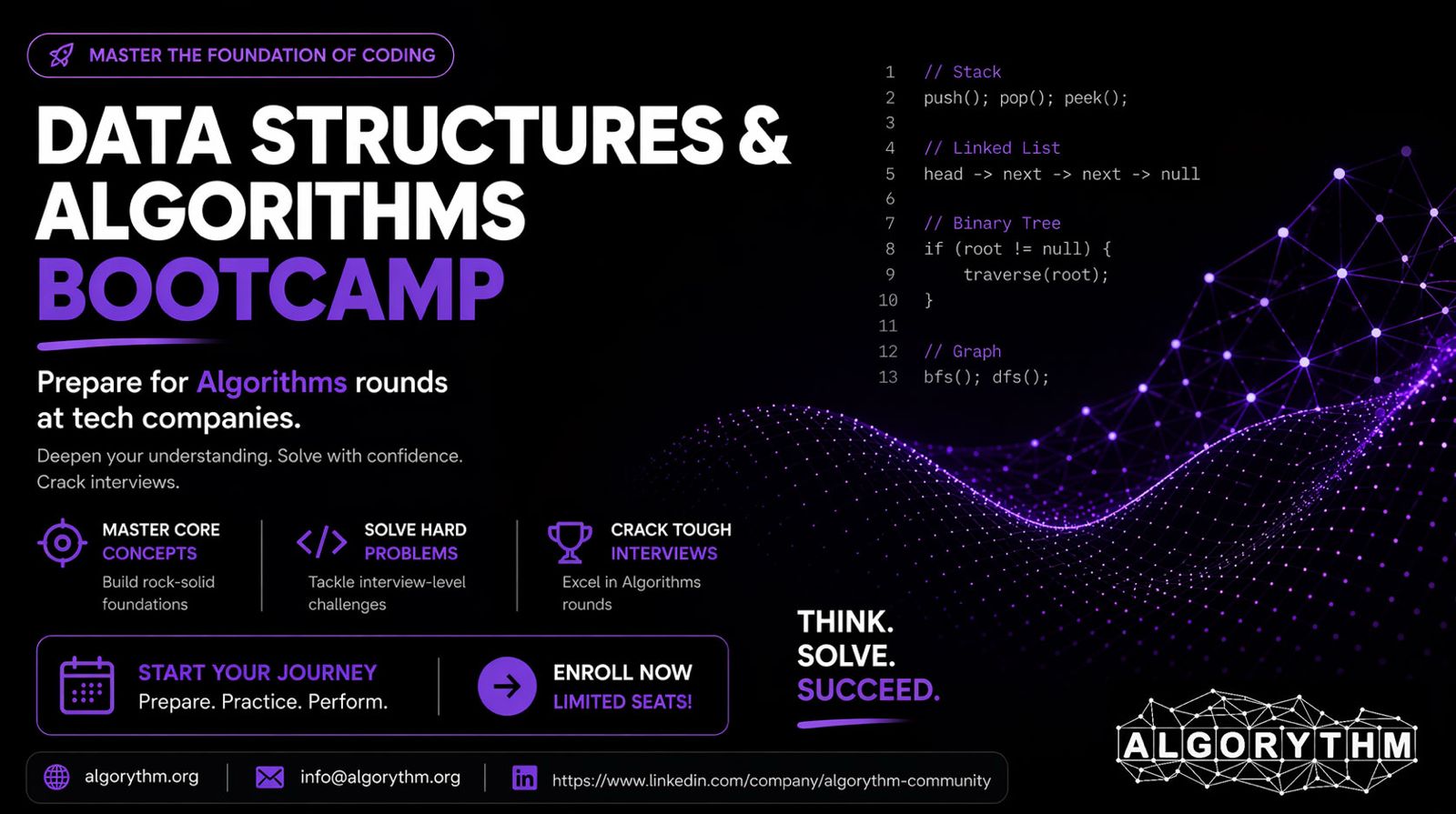
Algorythm's Data Structures & Algorithms Bootcamp is an intensive interview-preparation program with donation funded seats for 1,000 Underrepresented software engineers. As a 501(c)(3) nonprofit advancing the careers of underrepresented engineers, we're tackling the biggest barrier between talented candidates and the roles they deserve: the technical interview. Our philosophy is simple: coding is the easy part. 90% of your time will be spent on problem solving the skill that actually separates offers from rejections. We teach abstract concepts through diagrams and worked examples, so the ideas stick regardless of the language you interview in. Since complexity lives in the details around a pattern rather than the pattern itself, you'll get heavy exposure to the real challenges of applying algorithms under pressure.
What you'll master. The curriculum is built in layers, each making the next easier. You'll start with the fundamentals arrays, linked lists, stacks, queues, sets, hashmaps, trees, and graphs. By learning how they work, why they work, and how to implement them from scratch. From there you'll move into advanced structures like binary search trees, tries, heaps and priority queues, and LRU caches. You'll then learn the algorithms that bring those structures to life (BFS, DFS, binary search, Quick Select, and Dijkstra's), the sorts worth knowing cold (quick, merge, counting, and topological), and the patterns that show up again and again: recursion, backtracking, dynamic programming, divide & conquer, two pointers, greedy, and sliding window.
The goal is instinct. By the end of Q2 2026, when you see a problem, you'll recognize the pattern and write correct code fast — not from memorization, but from a real mental model of how these tools fit together.
Come ready to work.
Analyze algorithm efficiency using Big O notation for time and space complexity
Implement all basic data structures from scratch including Arrays
Linked Lists
Stacks
Queues
Sets
Hashmaps
Trees, and Graphs
Master advanced data structures including Binary Search Trees
Tries
Heaps
Priority Queues, and LRU Caches
Apply BFS
DFS, and Binary Search to traverse and query data structures efficiently
Implement Quick Sort
Merge Sort
Counting Sort, and Topological Sort from memory
Apply Quick Select and Dijkstra for advanced searching problems
Recognize and apply the most common interview patterns including Two Pointers
Sliding Window
Recursion
Backtracking
Dynamic Programming
Greedy Algorithms, and Divide and Conquer
Build problem-solving instincts so you can identify the right approach the moment you read a problem
Free for Members • Online
Apply to join the cohort, spot not guaranteed.